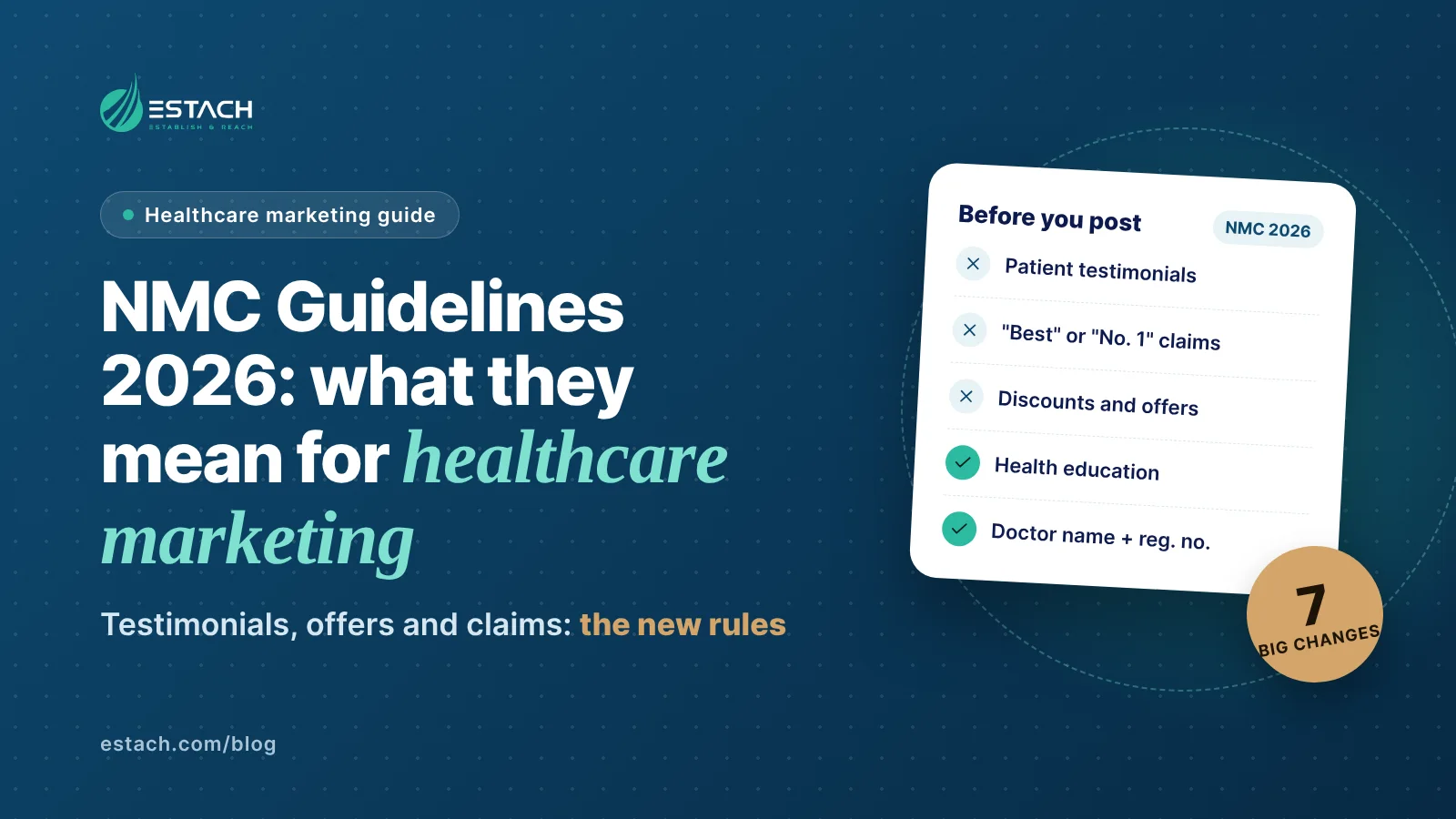
On 6 October 2026, the National Medical Commission (NMC) released its Guidelines on Ethical Advertising and Public Communication by Hospitals/Medical Institutions and Registered Medical Practitioners. They came into force immediately. There was no grace period.
Healthcare marketing in India has changed significantly with the rise of digital platforms. Patient testimonials, before-and-after photos, “best hospital in the city” claims, influencer-led promotion and festive health offers have become increasingly common ways for hospitals, clinics and doctors to attract attention and patients. Much of this promotional playbook is now facing tighter restrictions.
For doctors, the consequences can also be serious: repeated breaches of professional advertising rules can lead to disciplinary action, including removal from the medical register for a specified period.
Healthcare marketing itself isn’t banned. But the boundaries around how doctors, hospitals and clinics can promote their services have become much clearer, and more restrictive. This guide explains what the new NMC guidelines say, what they mean for healthcare marketing, and how hospitals and healthcare brands can continue building visibility and trust while staying compliant.
Why did the NMC introduce these guidelines?
The NMC’s tighter approach to healthcare advertising comes against a broader regulatory backdrop, including Supreme Court scrutiny of misleading advertising in healthcare. Doctors were already restricted from self-promotion under the 2002 professional conduct regulations, but the rules were less clear when it came to hospitals and third-party marketers. The new framework aims to apply more consistent standards across doctors, hospitals and those marketing healthcare on their behalf.
The NMC’s stated goals are to:
- Protect patients from misleading claims
- Prevent the commercialisation of healthcare
- Keep health communication factual and evidence-based
Who do the NMC guidelines apply to?
The guidelines cover:
- Registered medical practitioners (RMPs): every doctor registered with the NMC or a State Medical Council
- Hospitals, clinics and medical institutions: across all recognised systems of medicine
- Healthcare platforms: those that list doctors
- Agencies, digital marketing agencies and influencers: indirectly, through the doctors and hospitals they work for
They apply to every medium: websites, social media, WhatsApp and other messaging apps, podcasts, print, TV, radio, hoardings, influencer content, sponsored posts and AI-generated content.
7 big changes for healthcare marketing
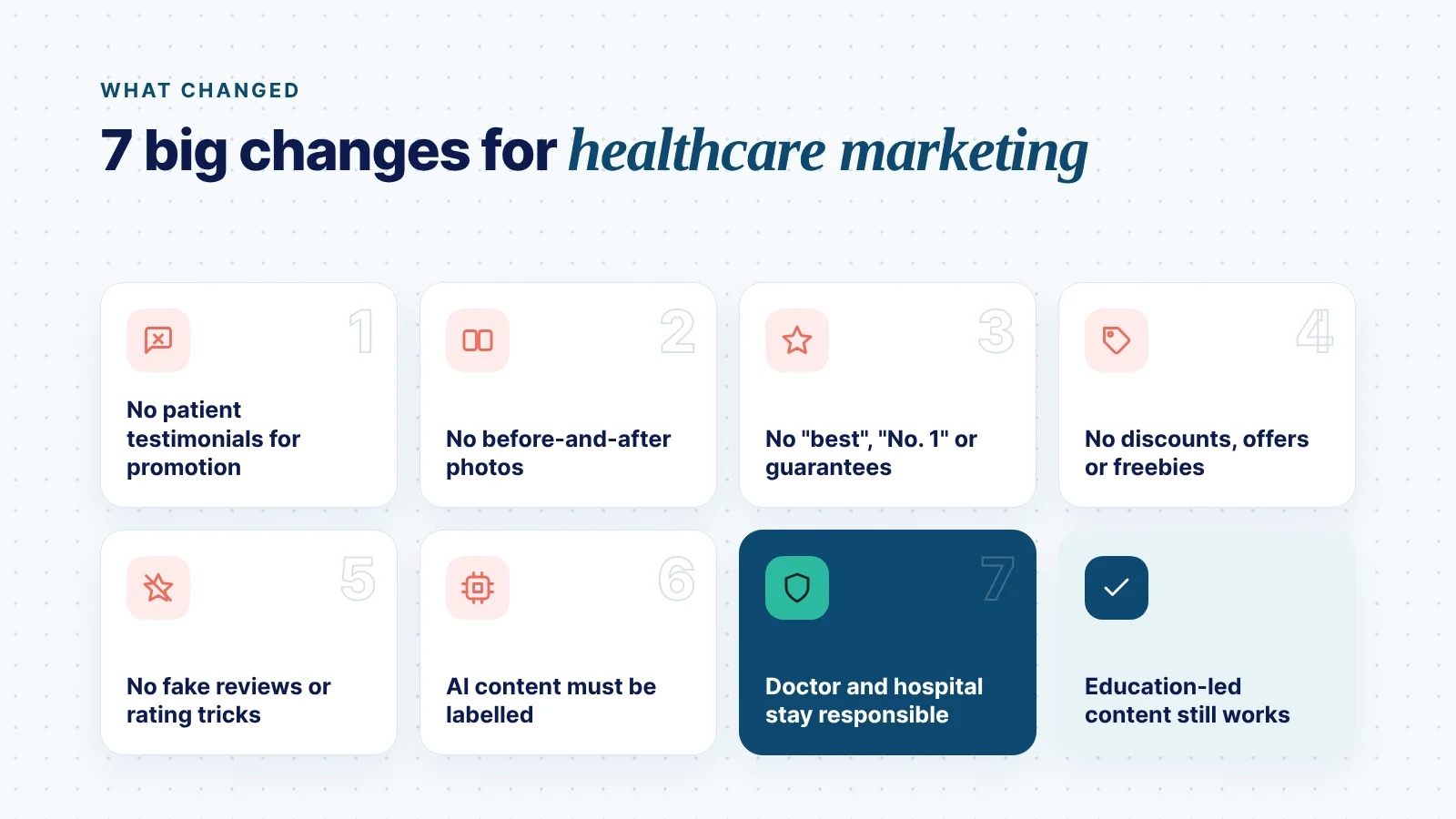
1. Patient testimonials can’t be used for promotion
Testimonials from patients, staff, celebrities or influencers can’t be used to promote a doctor or hospital. Doctors also can’t request or share patient testimonials on social media for professional promotion.
What this means for marketers the “happy patient” video, long the most popular format in healthcare marketing, can no longer be used as promotion. Existing testimonial posts should be reviewed and removed or archived.
2. Before-and-after photos and success stories are out
Advertising surgical results, before-and-after photos, celebrity patients and promotional success stories is prohibited. Patient case material is allowed only for genuine scientific or educational purposes, with proper consent, and anonymised.
What this means for marketers cosmetic surgery, dental, dermatology, hair transplant and weight-loss marketing are especially affected. Showing results now requires a different, education-led approach.
3. “Best,” “No. 1” and guaranteed results are banned
Superlatives such as “best,” “No. 1,” “leading” and “most trusted” aren’t allowed unless they can be objectively verified. Claims like “guaranteed cure,” “100% success,” “painless treatment” and “miracle treatment” are prohibited outright.
What this means for marketers this goes beyond social media captions. Website headlines, ad copy and even SEO page titles such as “Best Eye Hospital in Chennai” need a second look.
4. Discounts, offers and freebies are not allowed
Discounts, limited-time offers, contests, coupons, cashbacks and free procedures that may encourage unnecessary care are prohibited. Prices can still be shared, as long as they are factual and transparent.
What this means for marketers festive campaigns like “Deepavali offer: 20% off on full-body check-ups” are no longer an option. Seasonal content has to shift from offers to awareness.
5. Fake reviews and rating manipulation are clearly prohibited
Soliciting, buying or manipulating fake, paid or misleading reviews and ratings is banned. So are fake followers and likes, and attempts to manipulate search rankings or algorithms.
What this means for marketers any tactic that inflates reviews or engagement is now a professional-conduct risk for the doctor, not just a platform violation.
6. AI-generated content now has rules
- AI-generated promotional campaigns for commercial purposes are prohibited.
- AI content that is allowed must carry a clear label saying it was AI-generated.
- AI must never be used to create or alter a patient’s face, voice, testimonial or treatment outcome, or to create fake endorsements.
- Any patient data used in AI tools must comply with India’s privacy and data protection laws.
What this means for marketers AI avatars of “patients,” AI-written testimonials and synthetic doctor endorsements are off the table.
7. Responsibility stays with the doctor and the hospital
Content published through an agency, platform or influencer is still the responsibility of the doctor or hospital if they approved, commissioned or knowingly allowed it. Doctors can’t use third parties to do indirectly what they can’t do directly. Agency and influencer fees also can’t be tied to patient referrals.
What this means for marketers “the agency posted it” isn’t a defence. Hospitals need a proper review and approval process, and agency contracts shouldn’t use pay-per-patient models.
What hospitals and doctors can still do
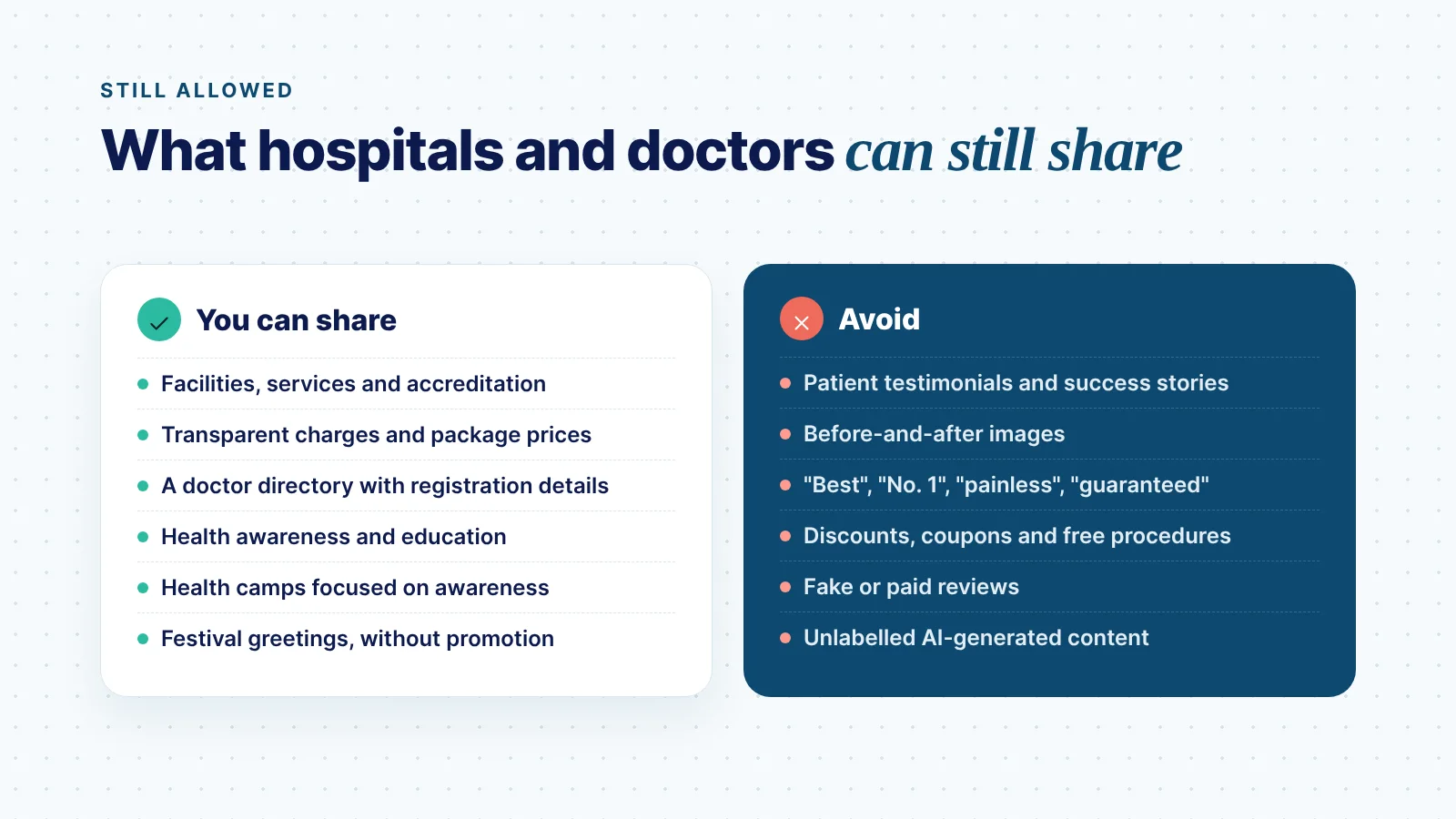
The guidelines don’t stop healthcare providers from communicating. They require communication to be factual, educational and non-promotional. Here’s what remains allowed.
| What you can share | The condition |
|---|---|
| Facilities, departments, services, equipment and accreditation | Factual, with no claims of superiority |
| Location, contact details and timings | Factual |
| Charges and package prices | Transparent and not misleading |
| A doctor directory on your website | Names, qualifications, specialities, registration details and availability |
| Health awareness and educational content | Must not solicit patients or promote the practice |
| Doctors on TV, radio, podcasts and talks | In their own name, without promoting their employer |
| Health camps and public campaigns | Focused on awareness, not patient acquisition |
| Hoardings and billboards | Factual infrastructure and facility information |
| Announcements | New clinic, change of address, timings or fees |
| Festival and national day greetings | Without promotional content |
What every healthcare post must now include
- Posts by doctors: must show the doctor’s name, qualifications and medical registration number.
- Posts by hospitals and clinics: must name the doctors involved and their credentials.
- Awards and rankings: must state who gave them, when and on what basis.
- Commercial relationships: behind health content must be disclosed.
- AI-generated content: must be labelled as AI-generated.
Penalties under the NMC guidelines
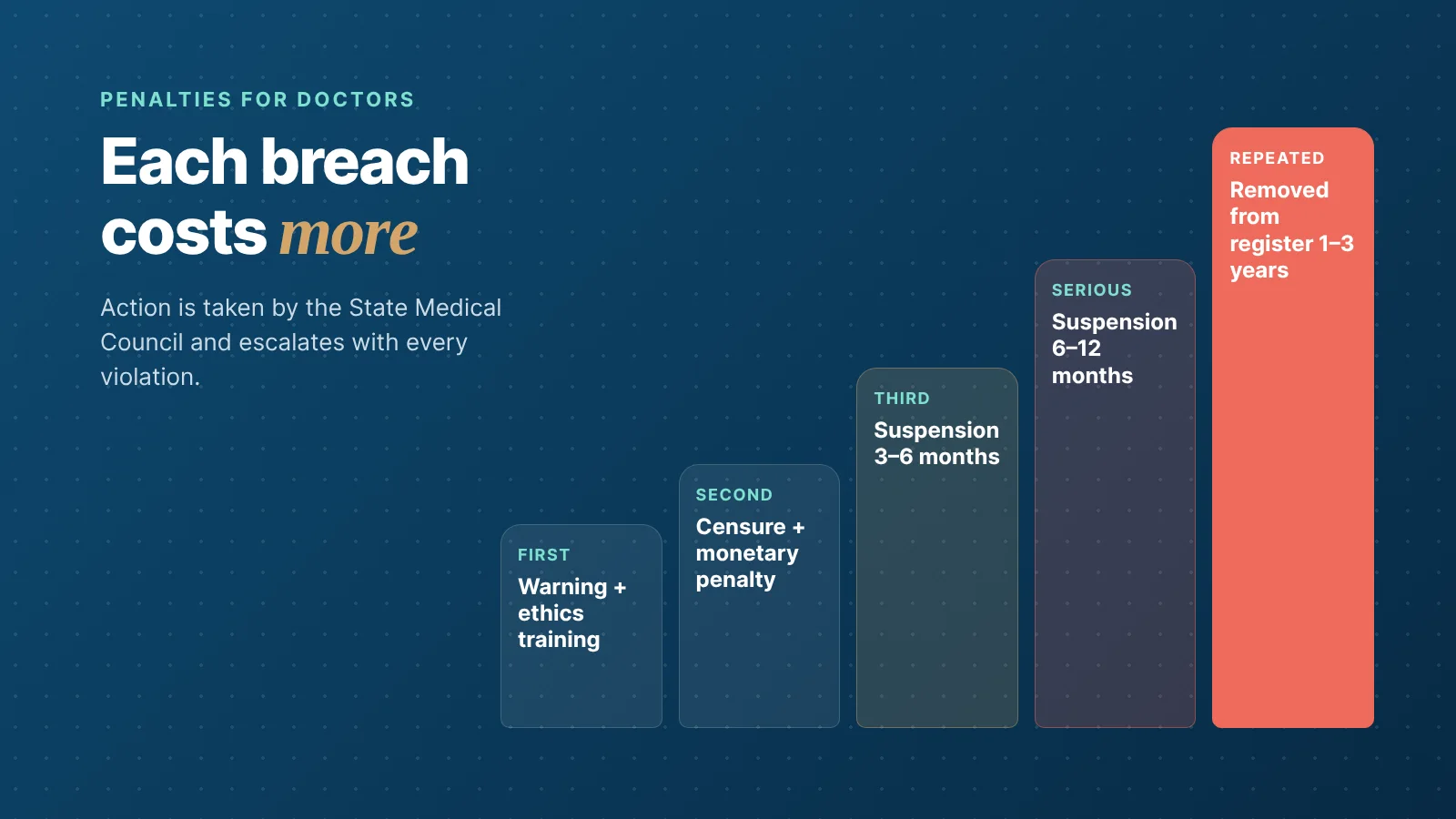
Action against doctors is taken by the State Medical Council and increases with each violation.
| Violation | Penalty |
|---|---|
| First | Warning and mandatory ethics training |
| Second | Censure and a monetary penalty |
| Third | Suspension of registration for 3 to 6 months |
| Serious (e.g. cure claims, inducements, mass digital solicitation) | Suspension for 6 to 12 months |
| Repeated | Removal from the medical register for 1 to 3 years |
Doctors get a show-cause notice and a chance to respond before any penalty, and can appeal. Hospitals face action under the Clinical Establishments Act and applicable state laws.
Grey areas to watch
Some questions aren’t fully answered yet, and the NMC has said it may issue clarifications.
- Paid ads and boosted posts: aren’t explicitly banned. However, the ad content must follow every rule above.
- Asking patients for Google reviews: fake and paid reviews are clearly prohibited. Asking genuine patients for reviews isn’t directly addressed, so tread carefully and never offer incentives.
- The line between education and promotion: a doctor explaining a condition is educational. Ending the same video with “book your appointment now” may cross into promotion.
- Google Business Profile: isn’t named specifically, but as a public medium it should stay factual.
The new healthcare marketing playbook
Healthcare marketing now rewards trust built through information, not persuasion through claims. That’s a better foundation anyway: patients research before they choose a doctor, and expertise is what convinces them.
Here’s what works within the rules:
- Education-led content: short videos and carousels explaining conditions, symptoms, prevention and when to see a doctor.
- Doctor-led awareness: doctors speaking in their own name about their speciality, with registration details shown, build credibility without self-promotion.
- Facility and process content: factual tours of departments, equipment and patient processes help patients know what to expect.
- Health awareness days and camps: use the health calendar (World Diabetes Day, Breast Cancer Awareness Month, World Sight Day) for awareness, not offers.
- Strong, factual websites: clear service pages, a complete doctor directory and transparent information about charges and timings.
- Local search visibility: an accurate, regularly updated Google Business Profile helps patients nearby find you.
- Consistency over claims: regular, helpful content builds familiarity. That’s what makes patients choose you, not superlatives.
NMC compliance checklist: 10 questions to ask before you post
Run every healthcare post, ad and web page through these questions:
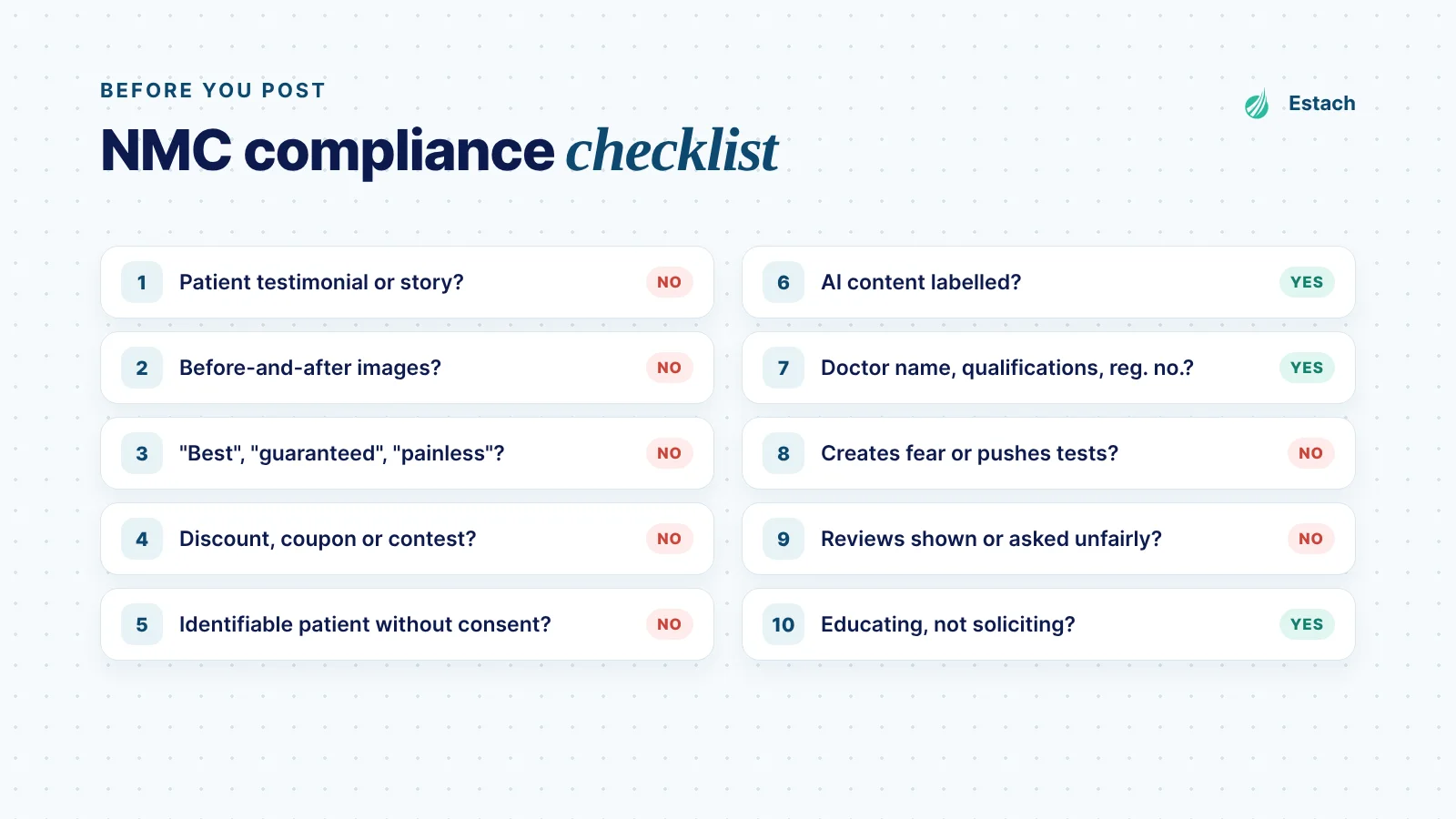
- Does it include a patient testimonial or patient story?
- Does it show before-and-after images or treatment results?
- Does it use words like “best,” “No. 1,” “leading,” “guaranteed” or “painless”?
- Does it offer a discount, free procedure, coupon or contest?
- Does it show an identifiable patient without legal basis and consent?
- Is any part AI-generated, and if so, is it labelled?
- Does it show the doctor’s name, qualifications and registration number?
- Could it create fear or push someone toward an unnecessary test or procedure?
- Is the ad or post asking for, or showing, reviews in a way that could be seen as manipulation?
- Is it educating, or is it soliciting patients?
If the answer to any of questions 1 to 5, 8 or 9 is yes, or to 6 or 7 is no, revise the post before it goes live.
How Estach can help
Estach has helped healthcare providers build their digital presence. For a multi-speciality hospital, that meant 1.5M+ video impressions and 600K+ interactions in 90 days. The new guidelines change how that work is done, not whether it can work.
We help hospitals, clinics and doctors with:
- Compliance audits: of existing social media, websites and ads
- Compliant content strategies: built around education and doctor-led awareness
- Website and service page updates: that are factual and still convert
- Local search: and Google Business Profile optimisation
- Approval workflows: so every post is reviewed before it goes live
Is your healthcare marketing compliant?
Book a free NMC compliance check with Estach. We’ll review your social media, website and ads, flag anything that may break the new guidelines, and show you how to keep growing within the rules. Book your free compliance check or call us at +91 91506 60660.
This article is for general information only and isn’t legal advice. For decisions specific to your practice, please consult a qualified legal or compliance professional.